
Central Air vs Mini Split: Which Fits?

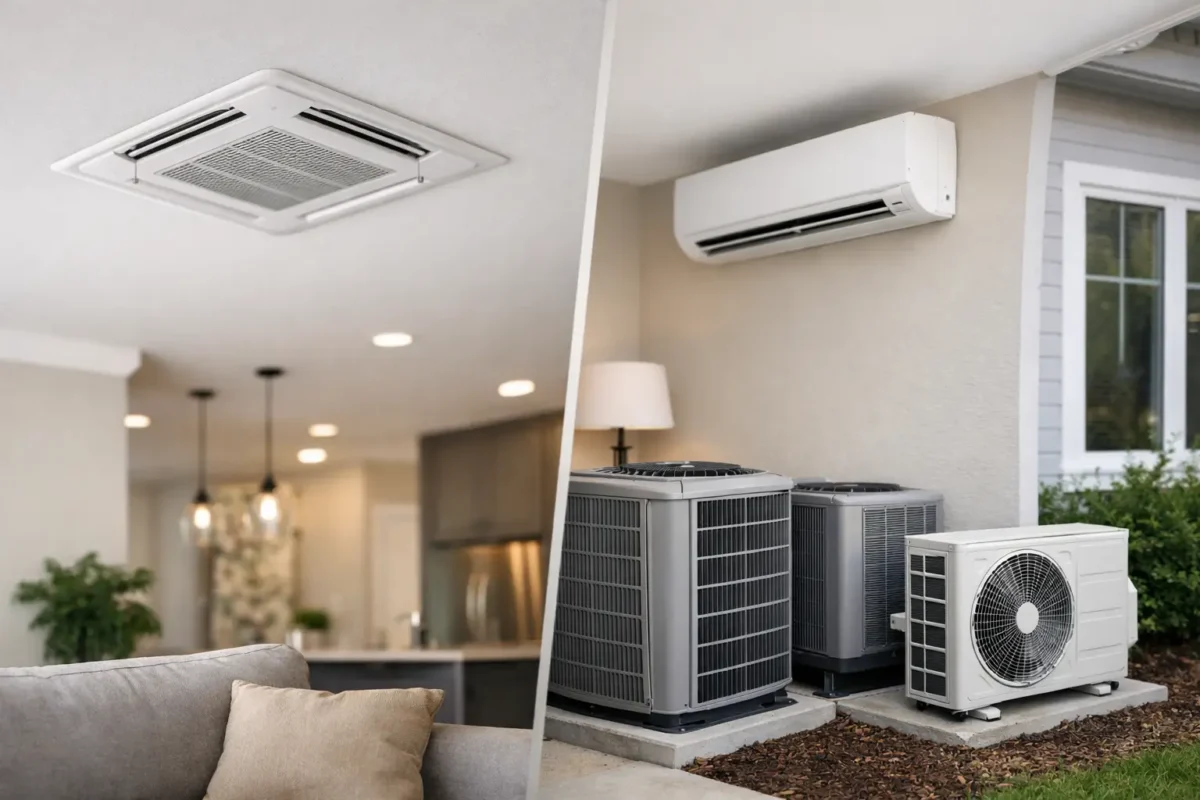
If your upstairs bedrooms stay warm while the living room feels like a freezer, the central air vs mini split question gets real fast. For many Bay Area homeowners, this is not just about equipment. It is about uneven comfort, rising utility bills, and making a smart replacement decision that will hold up for years.
The right choice depends on your home’s layout, your existing ductwork, your budget, and how you actually use each room. A system that works beautifully in one San Jose home can be the wrong fit in another. That is why it helps to compare both options in practical terms instead of chasing a one-size-fits-all answer.
Central air vs mini split: the core difference
Central air cools the whole home through a network of ducts. One indoor unit and one outdoor unit work together to send conditioned air to multiple rooms through vents. If your house already has well-designed ductwork, central air often feels familiar and straightforward.
A mini split, also called a ductless system, uses an outdoor unit connected to one or more indoor air handlers. Each indoor unit serves a specific room or zone. Instead of cooling the entire house the same way, mini splits let you control temperatures room by room.
That difference shapes almost every part of the decision, from installation cost to daily comfort.
When central air makes more sense
Central air is often the better fit when you want whole-home cooling from a single system and your home already has ducts in good condition. In that situation, installation can be cleaner and more cost-effective than adding several indoor mini split heads throughout the house.
For larger homes with many rooms in regular use, central air can also feel more cohesive. You set one temperature range, the system distributes air throughout the house, and the visual impact stays minimal because most of the equipment is hidden behind walls, ceilings, or in attic space.
There is also a lifestyle factor. Some homeowners simply do not want visible wall-mounted units in bedrooms, offices, or living areas. Central air keeps the look of the home more consistent.
That said, central air depends heavily on duct performance. If ducts are leaking, undersized, poorly insulated, or routed inefficiently, comfort and efficiency can suffer. In older homes, the system itself may be fine while the ductwork is the real problem.
When a mini split is the smarter option
Mini splits shine when your home does not have ducts or when existing ducts would be expensive to add, replace, or repair. They are especially useful for older homes, room additions, converted garages, ADUs, and houses with hot and cold spots that never seem to settle down.
Because each indoor unit creates its own zone, mini splits can reduce the common frustration of conditioning rooms that nobody is using. If you spend most of your time in a home office during the day and only need bedrooms cool at night, zoned control can lead to more efficient operation and better comfort.
They can also be a strong option for multi-story homes where one level runs warmer than another. Instead of forcing a central system to treat the whole house the same, a mini split setup can target the problem areas more precisely.
The trade-off is that mini splits are not invisible. Indoor units need wall, ceiling, or sometimes floor space, and homeowners vary widely in how they feel about that look.
Cost: upfront price vs long-term value
This is where many homeowners want a clear winner, but it depends.
If you already have solid ductwork, central air may come in at a lower installation cost for whole-home cooling. If your ducts are old, damaged, or missing altogether, that number can climb quickly. Duct installation or major duct repairs are not small add-ons. They change the project significantly.
Mini splits often have a higher cost per zone, especially if you need multiple indoor units. A single-room application can be very cost-effective. A whole-home multi-zone setup can become a larger investment.
Long-term operating costs also vary. Mini splits are often very efficient because they avoid duct losses and allow targeted temperature control. Central air can still perform efficiently, but only if the system is properly sized and the ductwork is in good shape.
The best way to look at cost is not just initial price. It is total value over time – installation, energy use, maintenance needs, expected lifespan, and whether the system actually solves the comfort issues you have now.
Comfort and temperature control
If your priority is even, whole-home cooling with a familiar thermostat setup, central air has a lot going for it. Many homeowners like the simplicity. One system, one control point, one consistent approach.
But consistent does not always mean precise. Some homes have sun-exposed rooms, upstairs heat buildup, or under-conditioned additions that central air struggles to balance. In those cases, a mini split often delivers better real-world comfort because it treats each area based on its needs.
This matters in the Bay Area, where microclimates and home designs can create surprising temperature differences. A south-facing room in the afternoon can feel very different from a shaded bedroom on the other side of the house.
If your household regularly argues over the thermostat, mini splits can be a peacekeeping tool. Different rooms can run at different temperatures, which is hard for a traditional central system to match without more complex zoning upgrades.
Energy efficiency and utility bills
Mini splits usually have the edge in efficiency, especially in homes without quality ductwork. Duct losses can waste a noticeable amount of conditioned air before it ever reaches the room you want to cool.
Zoning also helps mini splits avoid overcooling empty spaces. That can be a meaningful advantage for households with variable schedules, guest rooms that sit unused, or detached spaces that need occasional cooling.
Still, central air should not be written off as inefficient by default. A modern, properly sized central system paired with sealed and insulated ducts can perform very well. Problems usually show up when the equipment is oversized, the airflow is unbalanced, or the ductwork is neglected.
In other words, efficiency is not only about the type of system. Installation quality matters just as much.
Installation and disruption
Central air installation tends to be easier when the home already supports it. If ductwork is available and in usable condition, replacement may be relatively straightforward.
If ducts need to be added throughout the house, the project becomes more invasive. That can mean opening walls or ceilings, working through tight attic or crawl spaces, and spending more time on the job.
Mini splits are usually less disruptive in homes without ducts. Small line-set connections run between the outdoor and indoor units, so the installation footprint can be lighter than a full duct retrofit. For additions or targeted comfort upgrades, that is a major benefit.
But mini splits still require thoughtful design. Unit placement, line routing, drainage, electrical needs, and proper sizing all affect performance. A quick install is not the same as a correct one.
Maintenance and service considerations
Both systems need regular maintenance. Central air relies on filters, coils, refrigerant components, and duct-related airflow performance. Mini splits need filter cleaning, coil care, drain inspection, and servicing of each indoor unit.
A central system may be simpler from a homeowner perspective because there are fewer visible components inside the house. With mini splits, each indoor head needs attention over time.
Serviceability also matters. The cheapest installation is not a bargain if future maintenance becomes awkward or if the system was poorly designed from day one. Reliable performance starts with proper sizing and professional installation, not just the equipment brand.
Which system is better for your home?
Choose central air if your home already has good ductwork, you want a cleaner visual look, and you prefer whole-home cooling from one integrated system. It often makes the most sense for homeowners replacing an aging central unit with a modern equivalent.
Choose a mini split if your home lacks ducts, you want room-by-room control, or you need to solve hot and cold spots without major duct renovation. It is also a strong fit for additions, garages, and areas where central air has never performed well.
Sometimes the best answer is a hybrid approach. A home might keep central air in the main living spaces and add a mini split in a problem room, upstairs suite, or new addition. That kind of tailored solution often delivers better comfort than forcing one system to do everything.
For homeowners in San Jose and nearby communities, the smartest move is to base the decision on your actual home, not a generic rule. HVAC DOME helps homeowners compare real installation needs, energy goals, and comfort priorities with upfront recommendations that make the next step feel clear. The right system should lower stress, not add to it.
A good HVAC decision should make your home feel easier to live in every day – quieter mornings, more comfortable afternoons, and fewer surprises when the weather changes.